
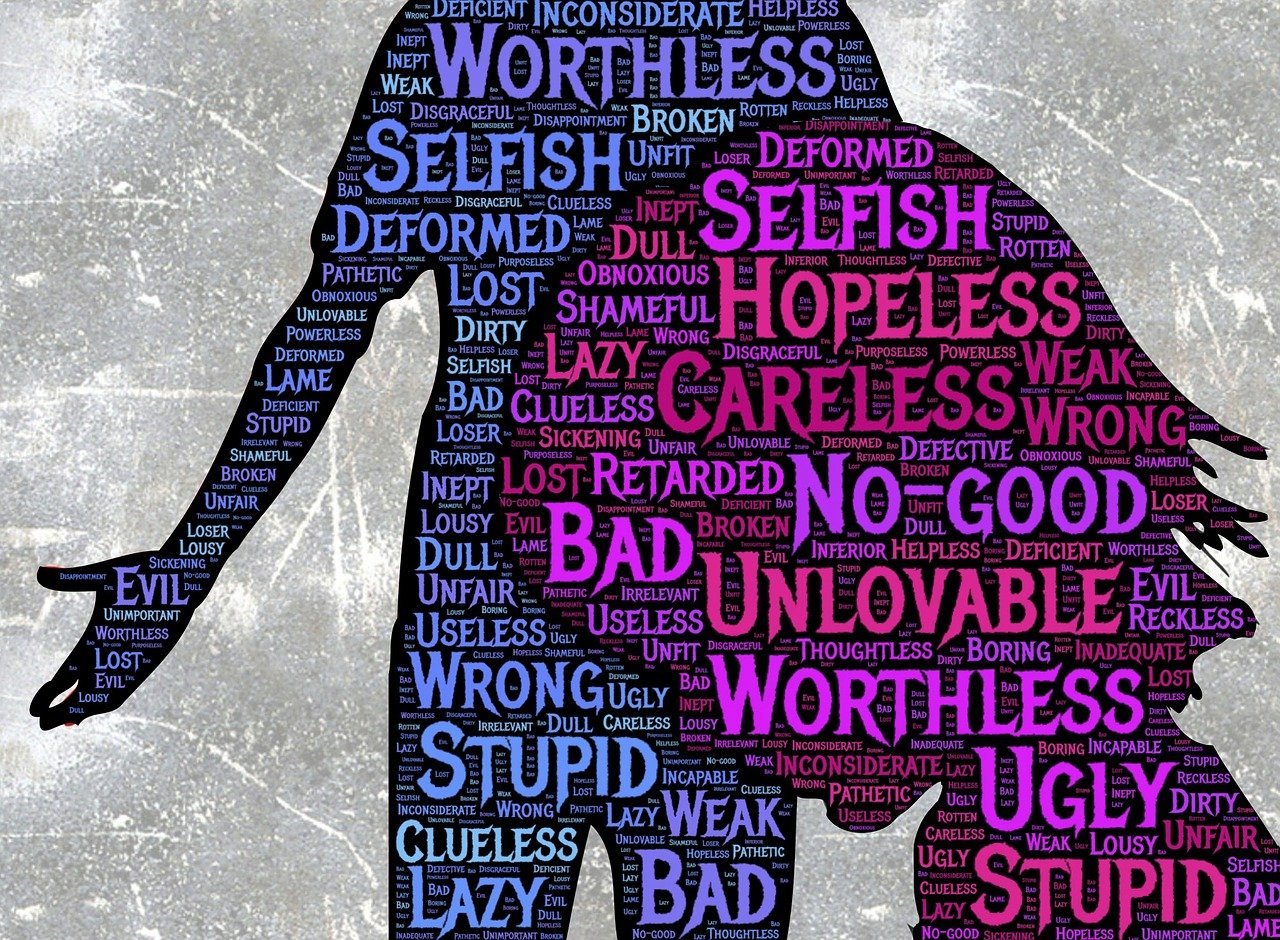
We all have a voice that tells us that we are not enough, that we are worthless or that we are horrible. For some this voice sounds very loud, she screams and it even seems that it is unbearable to live with her. I'm talking about self-criticism, which the RAE defines as the “critical judgment about one's own works or behaviors”. Per se, Following this definition it is not bad to have self-criticism, In the end it is an evaluation that allows us to see if what we do is in the direction of what we want to do.. However, Many times this judgment is distorted or is not really indicative of what is important to us and that is a problem.. Many of the clients I see have problems with this critical voice and it seems as if we were all born with this very negative evaluation of ourselves.. For this reason, let's see what happens, how this self-criticism is created, in order to understand it better.
The environment in which we grow up has a very important role in the language we have with ourselves. If this were a recipe, It would be important to have a good base in a demanding environment. In these environments, when a person emits a target behavior, may or may not, be ignored, but if she exhibits unwanted behavior, she is severely punished.. For example, if you collaborate on tasks, You speak politely or have good grades “it is your obligation”, but if you fail, One day you get lost or make a mistake and you face heavy punishments.. The models that these environments transmit to us are also important.. For example, if you see how anyone who makes a mistake is strongly criticized, you can learn that the mistake is something intolerable and you also acquire this language with those who commit it, even when that person is yourself. Finally, among other aspects, Maybe in this environment competition is highly rewarded, with siblings or other peers, which implicitly teaches you that you have to constantly prove your worth. In general, in these contexts, a message can be generated that marks how we talk to each other.: “I am not enough”. This is a good basis for negative self-criticism to start cooking.
In addition to the requirement, emotional invalidation is important. If the person learns that when they show emotions labeled as negative such as anger or sadness, is not taken seriously, They make fun of it or minimize it, she will start doing the same with herself. Therefore, yes when a little one says he is sad, We responded “it's not a big deal, there are worse people.”, you are likely to adopt this language and begin to use it with your own internal experiences.
Experiences of bullying or mistreatment are also key to creating negative self-criticism.. They especially have an effect if no intervention was made in these situations or the person felt unprotected.. The attacked person can make the language they have with them their own and in this way begin to speak worse to themselves.. Besides, Many times we blame ourselves for attacks we suffer (we'll talk about it another day), and this leads us to also feel guilty for the damage that has been done to us and consequently, to speak badly to us for it.
Belonging to a discriminated group also influences how we speak to each other, since this can make us more vulnerable to experiences of discrimination or aggression by peers., that shape our way of speaking to ourselves. Besides, We can blame ourselves for “not doing enough” for not being recognized or being able to overcome situations of structural discrimination that are not always in our power..
Finally, having models that blame us for not doing enough to achieve success also helps us talk less to ourselves.. If they tell me that I'm a fucking paunch for not getting up at 6 in the morning to do burpees, I will acquire this language with myself every time I do not comply with any of the rules that the influencer on duty imposes on me., Whether they are feasible in my routine or not.
In summary, to speak badly to you you learn. You are not born self-critical, you become so through interaction in contexts where this is reinforced.. This shows that, just as we have learned to speak to each other in a way, we can learn to talk to each other. I won't lie to you, change is not easy, takes work, but in therapy we can accompany you in this process to get you to relate to yourself in another way..